Conservation of the object "Ucieczka Świętej Rodziny do Egiptu"
Author: Ewa Tomaszewska
One of the objects of the District Museum in Leszno, which underwent conservation in 2024, is the sculptural group "Ucieczka Świętej Rodziny do Egiptu". It is a former altar section, a fragment of a larger whole, probably a dismantled altar cabinet, a late medieval polyptych.
The depicted scene belongs to the canon of Christian iconography, it is included in the cycle of Jesus' childhood. "Ucieczka do Egiptu" refers to the event described in the Gospel of St. Matthew, as well as the apocryphal text of the Gospel of Pseudo-Matthew. According to the Bible, an angel told Joseph in a dream to take the Child and His Mother to Egypt, because Herod wanted to kill Jesus. Joseph complied, and the Holy Family was to remain in Egypt until Herod's death.
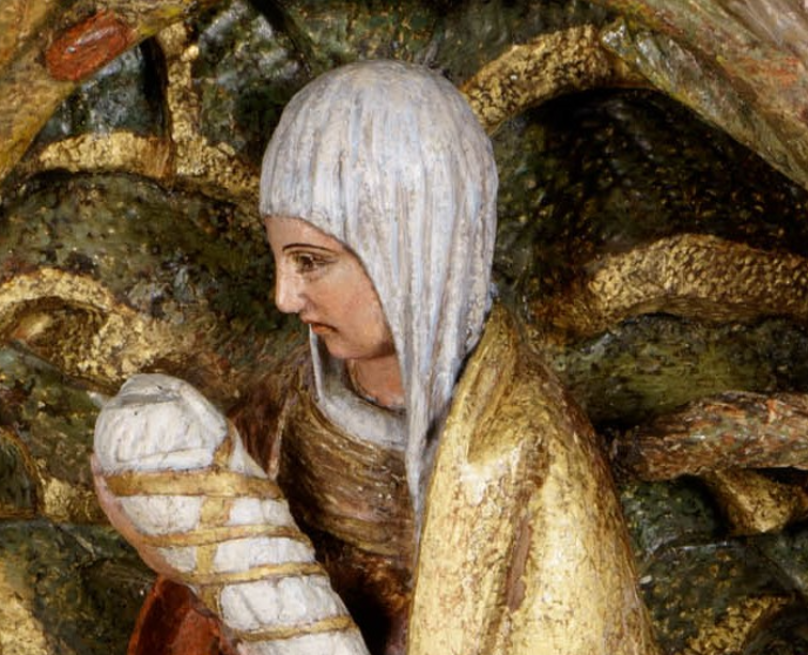
Since the Middle Ages, sacred art has been dominated by the established way of presenting "Ucieczka do Egiptu" as a profile group of people consisting of Mary holding the Child, sitting on the back of a donkey and Joseph leading an animal on a rope. Sometimes the Holy Family is accompanied by an angel or a group of angels. The described sculpture is part of the canon of representation. The figures are shown en trois quarts, with the central figure of the Virgin Mary holding the Child in a swaddling clothes, sitting sideways on a grey donkey. The head of the Virgin Mary is covered with a scarf in shades of whitened blue, the dress is silver-plated, the cloak is gilded, and the underside is vermilion. The white swaddling is girded with a gilded thong. St. Joseph, walking in front of the donkey, holds a rope with his left hand, resting his right hand on a leaning palm tree. A mature man with graying beard and hair wears a gilded cloak and carries a red/sienna bag on his back. In the background is a green wall of vegetation with a leaning palm tree canopy adorned with gilded decorative motifs. In the upper corners of the panel are figures of angels in gilded robes.
The sculptural representation was made of olive wood in the 16th century. The decoration on the face dates from the 19th century. The original polychrome panel was removed by soaking by a 19th-century restorer, as this was the standard conservation approach at the time. In the 20th century, the entire piece was covered with a unifying bronze oil glaze and additional elements. The goal of the conservative conservation work was to restore the technical and aesthetic qualities of the object, allowing it to be displayed in a museum. The task involved removing degraded layers of soil and 20th-century repainting to reveal the color effect and the original expression of the sculptural representation.
The conservation was carried out by the company ARCHIKON Conservation of Monuments, Andrzej Lipiński, Drużyna.
One of the objects of the District Museum in Leszno, which underwent conservation in 2024, is the sculptural group "Ucieczka Świętej Rodziny do Egiptu". It is a former altar section, a fragment of a larger whole, probably a dismantled altar cabinet, a late medieval polyptych.
The depicted scene belongs to the canon of Christian iconography, it is included in the cycle of Jesus' childhood. "Ucieczka do Egiptu" refers to the event described in the Gospel of St. Matthew, as well as the apocryphal text of the Gospel of Pseudo-Matthew. According to the Bible, an angel told Joseph in a dream to take the Child and His Mother to Egypt, because Herod wanted to kill Jesus. Joseph complied, and the Holy Family was to remain in Egypt until Herod's death.
Since the Middle Ages, sacred art has been dominated by the established way of presenting "Ucieczka do Egiptu" as a profile group of people consisting of Mary holding the Child, sitting on the back of a donkey and Joseph leading an animal on a rope. Sometimes the Holy Family is accompanied by an angel or a group of angels. The described sculpture is part of the canon of representation. The figures are shown en trois quarts, with the central figure of the Virgin Mary holding the Child in a swaddling clothes, sitting sideways on a grey donkey. The head of the Virgin Mary is covered with a scarf in shades of whitened blue, the dress is silver-plated, the cloak is gilded, and the underside is vermilion. The white swaddling is girded with a gilded thong. St. Joseph, walking in front of the donkey, holds a rope with his left hand, resting his right hand on a leaning palm tree. A mature man with graying beard and hair wears a gilded cloak and carries a red/sienna bag on his back. In the background is a green wall of vegetation with a leaning palm tree canopy adorned with gilded decorative motifs. In the upper corners of the panel are figures of angels in gilded robes.
The sculptural representation was made of olive wood in the 16th century. The decoration on the face dates from the 19th century. The original polychrome panel was removed by soaking by a 19th-century restorer, as this was the standard conservation approach at the time. In the 20th century, the entire piece was covered with a unifying bronze oil glaze and additional elements. The goal of the conservative conservation work was to restore the technical and aesthetic qualities of the object, allowing it to be displayed in a museum. The task involved removing degraded layers of soil and 20th-century repainting to reveal the color effect and the original expression of the sculptural representation.
The conservation was carried out by the company ARCHIKON Conservation of Monuments, Andrzej Lipiński, Drużyna.