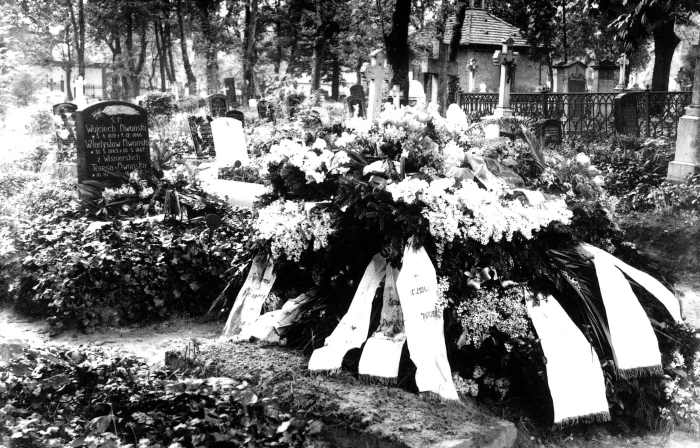
Former Catholic cemetery
Text: Artur Michalak
There were several cemeteries in the old Leszno and they corresponded to the religions of the townspeople. Learn about the history of burial places.
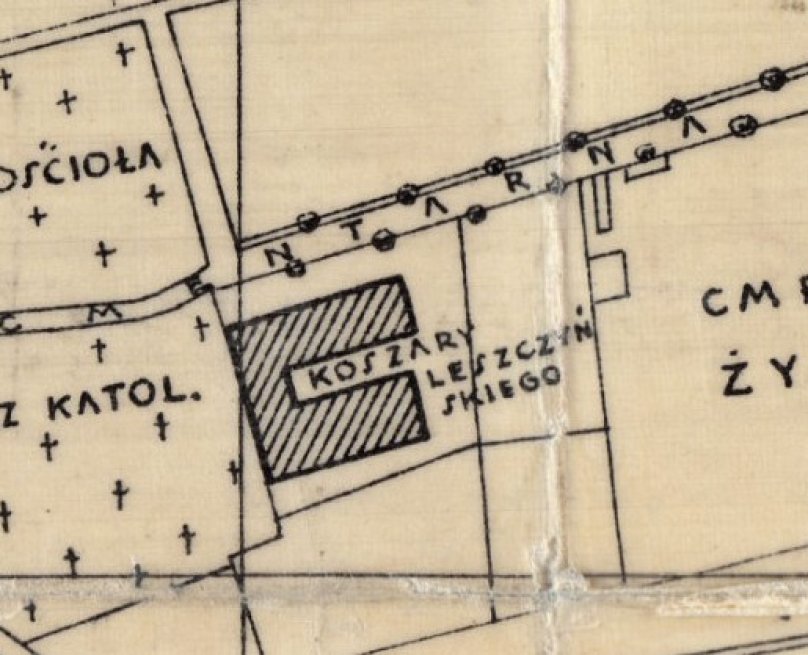
The Catholic cemetery in Leszno was established in 1809, and the land for the necropolis was donated in the then Rydzyńskie Suburb by Prince Antoni Paweł Sułkowski. The burial place was located in the immediate vicinity of the existing Evangelical Reformed cemetery, in the place where Jan Jonston Park is now located, and to the west of the Jewish cemetery (kirkut), located on the eastern side of today's Primary School No. 7 (at the intersection of today's John Paul II Avenue and Rev. Teodor Korcz Street).
In 1847, a morgue was erected in the cemetery, and later a chapel was added. The necropolis was a place of eternal rest for the faithful from Leszno, Gronowo and Grzybowo. Due to the limited area and the lack of possibility to enlarge it, at the beginning of the 20th century the lack of quarters for new burials was more and more noticeable. In addition, during World War I, in its eastern part, a military quarter was set aside for several dozen deceased soldiers. In 1928, it was decided to establish a new necropolis for Catholics – the cemetery at Kąkolewska Street. The last burial in the old cemetery took place in 1957. Over time, the necropolis was gradually devastated. On 17.03.1971 the Municipal National Council in Leszno decided to liquidate the cemetery, the liquidation works were carried out a year later. Unlike the previously flattened Protestant cemeteries, the families of the deceased could move the remains of their loved ones to the necropolis at Kąkolewska Street. The existing old Catholic cemetery in today's town center is only reminded by the remaining tree plantings.
There were several cemeteries in the old Leszno and they corresponded to the religions of the townspeople. Learn about the history of burial places.
The Catholic cemetery in Leszno was established in 1809, and the land for the necropolis was donated in the then Rydzyńskie Suburb by Prince Antoni Paweł Sułkowski. The burial place was located in the immediate vicinity of the existing Evangelical Reformed cemetery, in the place where Jan Jonston Park is now located, and to the west of the Jewish cemetery (kirkut), located on the eastern side of today's Primary School No. 7 (at the intersection of today's John Paul II Avenue and Rev. Teodor Korcz Street).
In 1847, a morgue was erected in the cemetery, and later a chapel was added. The necropolis was a place of eternal rest for the faithful from Leszno, Gronowo and Grzybowo. Due to the limited area and the lack of possibility to enlarge it, at the beginning of the 20th century the lack of quarters for new burials was more and more noticeable. In addition, during World War I, in its eastern part, a military quarter was set aside for several dozen deceased soldiers. In 1928, it was decided to establish a new necropolis for Catholics – the cemetery at Kąkolewska Street. The last burial in the old cemetery took place in 1957. Over time, the necropolis was gradually devastated. On 17.03.1971 the Municipal National Council in Leszno decided to liquidate the cemetery, the liquidation works were carried out a year later. Unlike the previously flattened Protestant cemeteries, the families of the deceased could move the remains of their loved ones to the necropolis at Kąkolewska Street. The existing old Catholic cemetery in today's town center is only reminded by the remaining tree plantings.
Graves of the Meritorious at the Leszno Cemetery, Głos Leszczyński, No. 252, 31.10.1937, p. 3.
Not only Poland as a country has it, but also almost every corner of our great homeland. They are not meritorious as great statesmen and excellent leaders of the nation, for one place they have merits no less than they do for the whole state organism. This part for the deserving, which the Romans called pietas, and we call pietism, gratitude, attachment, should be cultivated. - It is the mark of a nation that respects itself. Yes, the awareness of one's own worth can be measured by the intensity of memory dedicated to one's ancestors, especially the best of them. Among those buried in our Leszno cemetery are the graves of professors Popliński and Karwowski, doctors Stawicki and Putiatycki, and several soldiers. The Cemetery Board took care of them, removed the stains of destruction that creep in over the years, cleaned them and decorated them with flowers where possible. Jan Popliński, professor of Polish, distinguished editor of Przyjaciel Ludu, died on March 17, 1832, has a grave on the right side of the main porch. His tombstone has been repaired. Adam Pucjata Karwowski, professor of history, cadet of the 14th Infantry Regiment of the Polish Army in 1830/31, born 24 December 1812, died 11 August 1886, rests in the left, front section. He has a modest gravestone, but neat after the last tidying up. Dr. Feliks Putiatycki, a doctor, a faithful son of the Church, caring for the parish church, as it appears from the parish archives, born on 16. 8. 1857 in Leszno and died in Leszno on 17. 2. 1901 at the age of 44, and already full of merits. His grave is covered by a marble slab, which was thoroughly cleaned. Dr. J. Stawicki, captain - doctor, born in Błociszew, died at the age of 34 in the service of the Homeland on July 30, 1920. His tombstone, improvised from a slab that had been used as a washbasin, clearly testifies to the conditions in which he died, especially with its inscription: Thy will be done. His grave was decorated with begonias, a sad and serious flower. Finally, there are gravestones without graves of Erazm Osiński. former officer of Napoleon's army, born 1794, died 1850, in the vicinity there are commemorative plaques. Plaques of the late Karol Simon, former officer cadet of the Polish Army, born 18/05/1814, died 13/04/1879, and finally two young soldiers of the German army, one of them a Pole, Józef Sobkowiak, who died in 1875, at the age of 23, for whom the fourth squadron of the 2nd Private Hussar Regiment, then stationed in Leszno, founded this plaque. This is all that can be determined from the more noteworthy graves. It is clear that there was not much of this pietas, mentioned at the beginning, since only this much has survived to our times, and everything else has been screwed up. Let us therefore be more sensitive on this point than the previous generation. On the occasion of All Souls' Day, let us pray over the graves of our distinguished ones, let us take care of their graves, because we are worth as much as the memory we dedicate to the dearly departed.