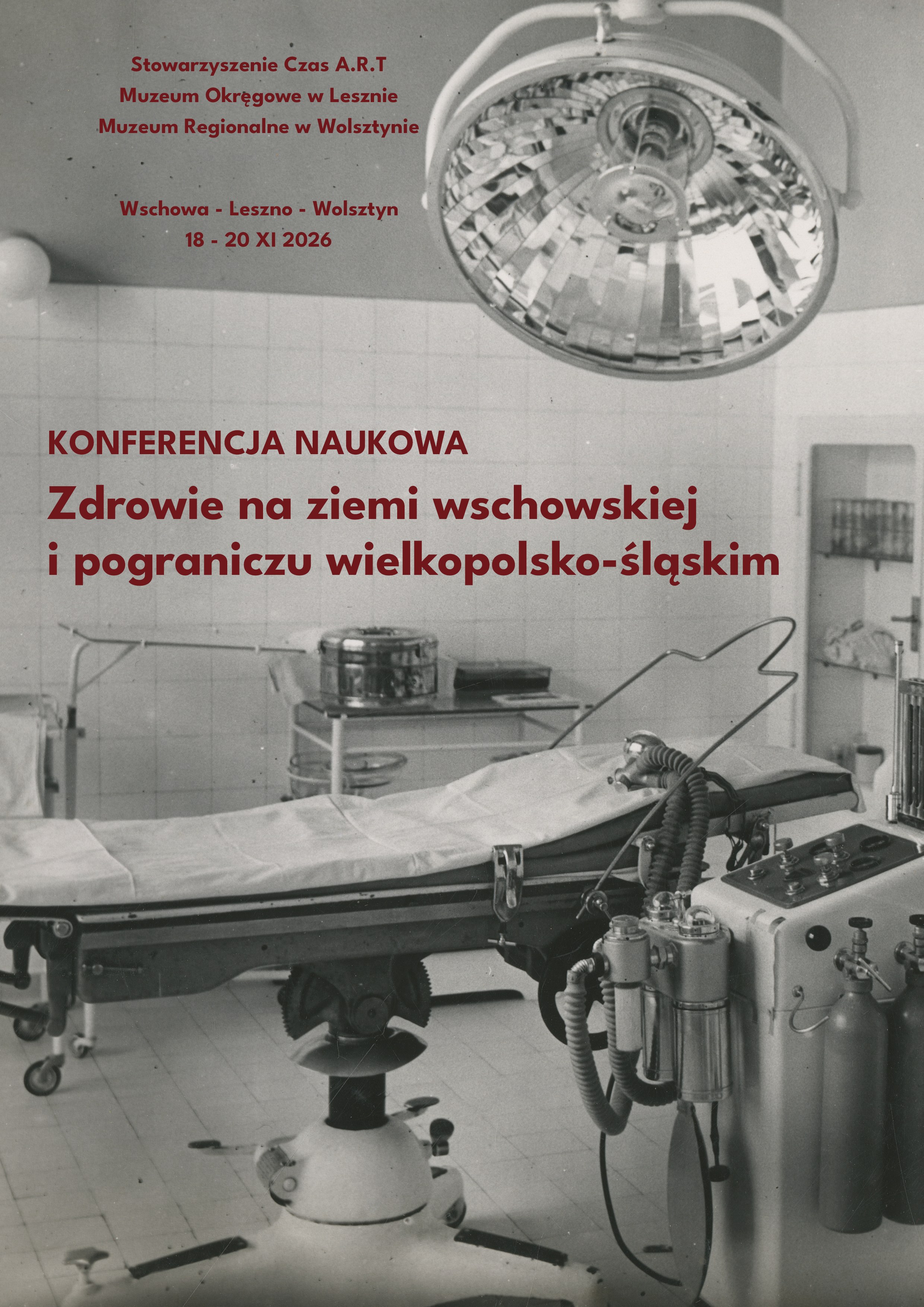
Academic Conference: "Health in the Wschowa Region and the Greater Poland-Silesia Borderland"
The Czas A.R.T. Association, the District Museum in Leszno, and the Regional Museum in Wolsztyn invite you to participate in the academic conference "Health in the Wschowa Region and the Greater Poland-Silesia Borderland."
Wschowa–Leszno–Wolsztyn, November 18–20, 2026
In 2026, we would like to invite you to participate in an academic conference dedicated to broadly defined health issues. The aim of the meeting will be to exchange research findings and foster academic reflection on the diverse aspects of human health care—encompassing medical, social, and cultural dimensions.
The history of medicine includes several prominent figures associated with the Wschowa region, such as Matthaeus Vechner (1587–1630), Jan Jonston (1603–1675), Ernest Jeremias Neifeld (1721–1773), Jerzy Christian Arnold (1747–1827), and Johann Metzig (1804–1868). The medical community also encompassed pharmacists, barbersurgeons, and other practitioners involved in treatment and disease prevention. It was in Leszno that the first medical journal in the Polish lands, "Primitiae physico-medicae…", was published in 1750, while Robert Koch (1842–1910)—a Nobel laureate in medicine—worked in Wolsztyn.
Care for the sick, the poor, and the needy was organized primarily by parishes and religious orders. Their activities laid the foundations for the development of modern hospital systems. Over time, the residents themselves also established foundations aimed at providing assistance to those in need.
Another crucial issue is the world of folk beliefs concerning health and illness, which intertwined with the spiritual dimension of human life. The fear of suffering and death drove people to resort to both magical and astrological practices, as well as the teachings of the Church. The map of the Wschowa region and neighboring areas featured pilgrimage sites visited by those seeking healing. These included the Church of St. Joseph the Betrothed of the Blessed Virgin Mary in Wschowa, the Sanctuary in Górka Duchowna, the Cistercian monasteries in Wieleń and Obra, as well as Silesian pilgrimage centers such as Grodowiec and Piersna.
Historical sources also tell us that the inhabitants of the Wschowa region often sought to improve their health by traveling "to the springs." They looked for such places both in well-known health resorts, like Cieplice, and in smaller centers, including nearby Jemielno. We have set the year 1945 as the cutoff point for the accounts mentioned.
We encourage you to undertake academic reflection on issues related to broadly defined health—not only in the Wschowa region but also in its neighboring borderlands.
We particularly recommend the following topics for your consideration:
- diseases and epidemics
- people of medicine: their social status, prominent figures, and achievements
- medicines, prescriptions, pharmacies, and the trade in medications
- literature dedicated to health and medicine
- organization of care for the sick and the poor
- hospital systems and institutional care
- healthcare prevention: hygiene, rest, and physical activity
- spas, hydrotherapy, and other forms of therapy
- spiritual aspects of healthcare
- sites of healing, pilgrimages, and miraculous recoveries
- folk beliefs related to health and illness
- astrology and its role in medicine
- historical events related to public health and healthcare
The sessions will take place in three locations:
18 Nov 2026 – Wschowa
19 Nov 2026 – Leszno
20 Nov 2026 – Wolsztyn (off-site session)
Participation rules:
- We invite researchers from various academic disciplines to participate in the conference, including historians, archaeologists, art historians, geographers, demographers, anthropologists, literary scholars, theologians, religious studies scholars, and sociologists.
- The organizers will provide meals during the conference, as well as transport to Wolsztyn and the return trip to Leszno on November 20, 2026.
- The presentation is scheduled for 20 minutes.
- Multimedia equipment will be made available to you.
- The conference fee is PLN 200.00 and is payable to the District Museum in Leszno.
- A peer-reviewed collection of papers is planned to be published following the conference.
- The deadline for applications (using the form below) is October 20, 2026. Please send them to: szymanskamila68@gmail.com or malkus.marta@gmail.com.
Contact:
Marta Małkus, phone: 607 849 700
Kamila Szymańska, phone: 693 430 041
Bogusław Kosel, phone: 500 600 661
Kamila Szymańska, phone: 693 430 041
Bogusław Kosel, phone: 500 600 661